


B.Sc. Medical Laboratory Technology – The Backbone of Modern Diagnostics
Medical Laboratory Technology is a key Allied Health Science discipline focused on the diagnosis and management of diseases through a wide range of clinical laboratory tests. As essential members of the healthcare team, medical laboratory professionals play a crucial role in providing accurate and timely diagnostic information that guides effective patient care and treatment. In today's world, modern medical practice is incomplete without laboratory testing, making Medical Laboratory Technologists indispensable to quality healthcare.
About the Course
Medical Laboratory Technologists thrive as skilled professionals in hospitals, clinics, and advanced diagnostic centres. They also join leading commercial laboratories with opportunities for rapid career growth, and can step into academia as inspiring educators and trainers in medical institutions.
Graduates can advance their expertise through prestigious M.Sc. and Ph.D. programs, opening doors to specialization and research excellence.
Scope and Future Prospects
Thrive as Skilled Laboratory Technologists in hospitals, clinics, and advanced diagnostic centres. Join leading commercial laboratories with opportunities for rapid career growth.
Step into academia as inspiring educators and trainers in medical institutions. Advance your expertise through prestigious M.Sc. and Ph.D. programs, opening doors to specialization and research excellence.
Career Paths
Career Opportunities
Award of Degree, Internship & Clinical Facilities
Upon successful completion of the final year examination and internship, the candidate will receive a Bachelor of Science degree in Medical Laboratory Technology. After passing the final university examination, students are eligible to embark on the Compulsory Rotatory Internship, which is a mandatory requirement for obtaining the BSc. Medical Laboratory Technology degree.
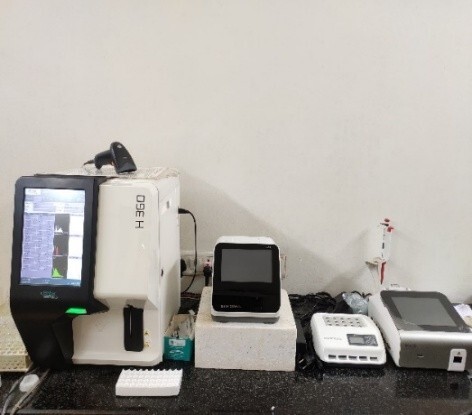
Students receive extensive hands-on training across a wide range of clinical laboratories, including Clinical Haematology, Clinical Biochemistry, Clinical Pathology, Clinical Microbiology (Bacteriology, Mycology, Virology & Parasitology), Clinical Immunology, and Transfusion Medicine. These laboratories are equipped with state-of-the-art instruments, allowing students to train on advanced technologies such as Auto-analysers, Immunofluorescence, ELISA, Western Blot, PCR, and Hormonal Analysis.
In addition, the department features both an Analytical Laboratory and a Multi-purpose Laboratory designed specifically for student practical sessions. These labs are fully equipped with microscopes, centrifuges, spectrophotometers, weighing balances, water baths, incubators, hot-air ovens, pH meters, and more — providing a spacious, well-structured, and student-friendly environment for both guided learning and independent practice.
Why Choose This Program?
Here are three compelling reasons to pursue B.Sc. Medical Laboratory Technology:
- Critical role in disease diagnosis with advanced diagnostic technologies
- Diverse career opportunities in hospitals, laboratories, and research facilities
- State-of-the-art laboratory training with sophisticated instruments
Overall, the B.Sc. Medical Laboratory Technology program provides comprehensive training that combines theoretical knowledge with extensive practical laboratory experience, preparing graduates for essential roles in the healthcare system where accurate diagnostics drive patient outcomes.
